How AI has changed workforce capability priorities
Get the latest insights from industry experts every month
AI capability is a priority for 83% of learning leaders, yet only 29% of organizations have built mature AI capabilities.
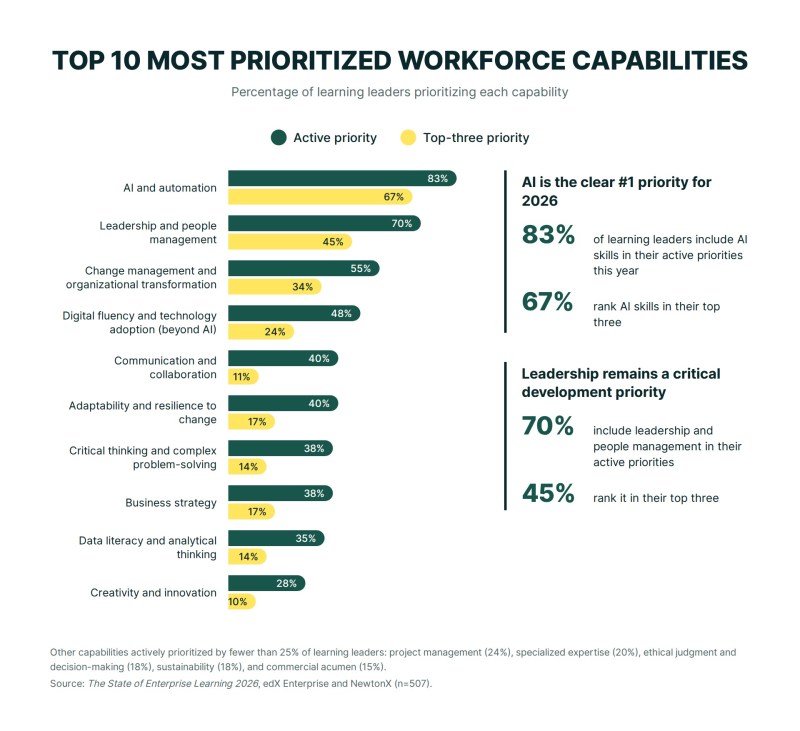
Putting AI at the top of the agenda was the easy part. Now most organizations are working out how to build the capability behind it. Eighty-three percent of learning leaders in our research name AI an active workforce priority, more than any other capability.1 Yet only 29% of organizations have built mature AI capabilities.2 That gap doesn’t reflect a lack of intent or willingness. If your organization sits in the gap, you’re with the majority.
In our first article, we introduced The State of Enterprise Learning 2026, edX’s new report produced with global B2B research firm NewtonX. In this second article of our four-part series, we look at what learning leaders are prioritizing, how far that intent has turned into progress, what the research indicates is causing the gap and how to start closing it.
What learning leaders are prioritizing
AI tops the list, and the skills that support it follow
For today’s learning leaders, the debate over whether AI matters is long settled. AI and automation is the most-cited workforce capability priority. Two-thirds of learning leaders (67%) rank it in their top three (Figure 1).3
[Figure 1: Top 10 most prioritized workforce capabilities, report slide 6]
Examining the full spectrum of priorities in Figure 1 reveals an emerging pattern. Below AI sit the human capabilities an AI transition leans on. Leadership comes second, named by 70% of learning leaders. Then come the skills people need to steer change: leading transformation, adopting new technology, communicating, adapting and thinking critically about problems without obvious answers.4 These are not competing priorities. They are the supporting capabilities that help AI investment pay off. Without them, an AI strategy places powerful technology in employees’ hands without the judgment to use it well.
Intent is high. Progress is lagging
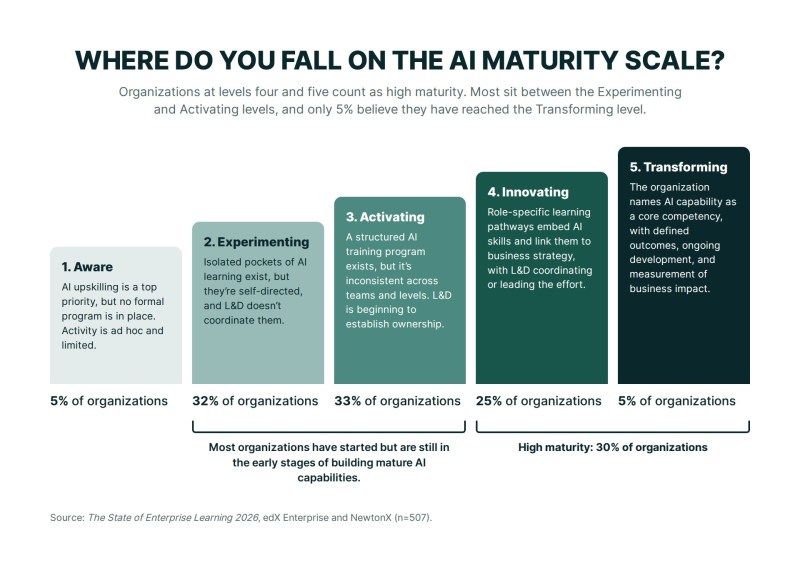
By learning leaders’ own assessment, only 29% of organizations have built mature AI capabilities.5 Most sit between the Experimenting and Activating stages of the report’s five-stage AI maturity scale. Just 5% have reached the final stage, Transforming.6 Confidence is lagging too. Only 26% of learning leaders are highly confident their L&D function can deliver what the workforce needs.7 Just 15% of organizations claim they have achieved high maturity and are confident their L&D function can keep delivering to meet the upskilling needs that transformation demands. The report classifies these organizations as AI transformation leaders.8
[Figure 2: AI Maturity Scale]
For those lagging; intent isn’t the problem. L&D leaders are prioritizing the right capabilities but the transformation isn’t moving at the pace AI demands. That gap between intent and capability sits at the heart of the report.
Most organizations are bolting AI on, not redesigning for it
The way AI has influenced priorities helps explain why. Eighty-four percent of learning leaders say AI has influenced their workforce priorities over the past 12 to 18 months. A mere 14% say it has fundamentally reshaped them. For the other 70%, AI has moderately influenced or significantly shifted priorities. The report reads that as an additive response, with AI added to existing learning agendas (Figure 3).9
The AI skill priorities show the same pattern. Day-to-day AI fluency leads at 56%, followed by applying AI to business processes (52%) and AI awareness and literacy (45%). Re-engineering workflows and embedding AI into core processes is a top-five priority for only 36% (Figure 4).10 That’s the part where work itself gets redesigned around AI. Fluency is the right starting point. On its own, it teaches people to do current tasks faster without asking whether those tasks should change or if new capabilities are needed alongside these new tools. AI is a general-purpose technology that runs across every role and function.11 The report argues AI needs to be built into the capability agenda itself, alongside the leadership skills that guide the change.
[Figure 4: Top 5 AI skill priorities, report slide 7]
“You can bolt on new AI courses to an unchanged L&D structure, but you can’t bolt transformation onto it.” -Chris Kelly, Director, Strategic Insights and Analytics, NewtonX
McKinsey’s State of AI in 2026 shows what this execution gap costs. Eighty percent of respondents say AI has improved their own productivity. Only 37% say it has made a measurable difference to their company’s bottom line, a figure that hasn’t moved in a year. 12 McKinsey’s AI high performers, the 6% of organizations seeing real financial results, have changed how work gets done. Nearly three in four have restructured their workflows around AI, compared with about one in four of their peers.13
Many programs stop at introducing AI
In many organizations, the first wave of AI learning introduces the tools: what AI can do, where to find it and how to get started. That’s a necessary first step, but introducing AI isn’t the same as building the capability to use it well. As one of the 10 experts NewtonX interviewed for the study puts it:
“We are just introducing AI, we are not upskilling the people. This is just the introduction. Upskilling still needs effort.” – Head of Talent and Capability Development, Pharmaceuticals, UAE
What’s causing the gap
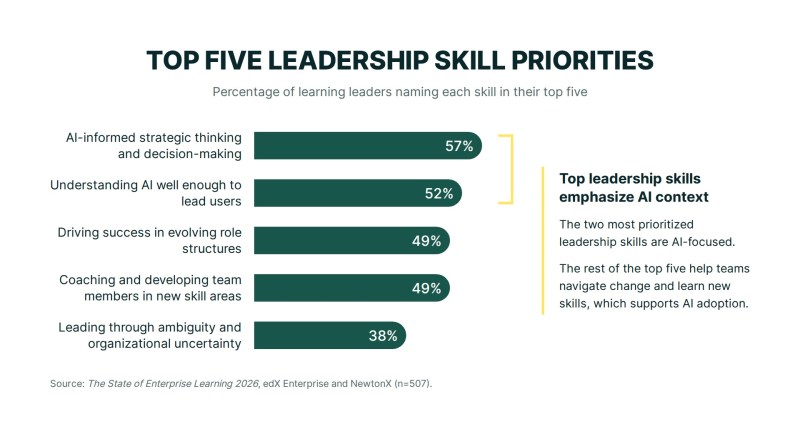
AI is also redefining what it means to lead. The two leadership skills learning leaders prioritize most revolve around AI: AI-informed strategic thinking and decision-making (57%) and understanding AI well enough to lead its users (52%). The rest of the top five help managers carry teams through AI-driven change (Figure 5).14
[Figure 5: Top 5 leadership skill priorities, report slide 7]
Learning leaders know which capabilities matter. Most are building them on separate tracks. The report finds AI upskilling is often pursued apart from other L&D efforts. It identifies that separation as an obstacle to AI transformation.
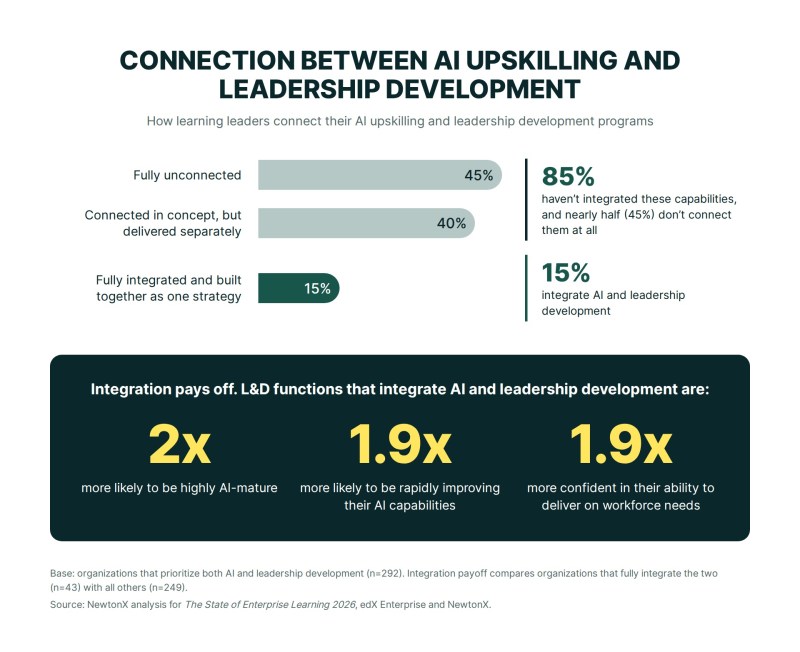
The organizations that integrate them stand out. They’re twice as likely to be highly AI-mature. They’re 1.9 times as likely to be rapidly improving their AI capabilities. They’re also 1.9 times as likely to be confident they can deliver on workforce needs (Figure 6).15
[Figure 6: How integrating AI and leadership development pays off, slide reference to confirm]
Yet most organizations continue to build AI and leadership capabilities in silos. Among organizations that prioritize AI and leadership development, 85% don’t develop them as one connected effort. Nearly half (45%) don’t connect them at all.16 The two priorities most essential to an AI transition run on disconnected tracks.
AI transformation leaders also lean hardest into the capabilities that complement AI. They prioritize AI-informed strategic thinking far more than their peers (83% vs. 53%), along with digital fluency beyond AI (62% vs. 46%) and critical thinking and problem-solving (51% vs. 36%). 17 Rather than favoring human capabilities over AI, they treat these human skills as the foundation for AI adoption. They also integrate AI upskilling with leadership development at 2.7 times the rate of other organizations.18
Separate tracks aren’t the only blocker. The report’s driver analysis finds that a strong executive mandate is the strongest predictor of AI transformation leadership.19 Seventy-eight percent of learning leaders lack one, meaning executive support, clarity and resources together.20 We explore mandate in Part 3 of this series.
AI is spreading faster than any technology before it
Redesigning learning around AI can feel out of reach for most organizations. The pace of adoption makes waiting risky. Microsoft’s AI Diffusion Report found that more than 1.2 billion people used AI tools in less than three years.21 That’s faster than the internet, the personal computer or the smartphone spread. Organizations won’t get decades to adjust. The gap between those that redesign and those that bolt on will open in year
How to start closing the gap
The differentiator is no longer knowing which capabilities to prioritize. It’s building them together and applying them on the job. The research points to five places to start.
Map AI capabilities to roles. The most proactive organizations work with functional leaders to map specific AI capabilities to specific roles and business units.22 That shows them where development will have the highest impact.
Build AI and leadership development as one effort. Weave AI into leadership programs and leadership context into AI training. Target the integration by audience. Everyone needs baseline AI fluency. Managers and executives also need AI-informed strategic thinking and the confidence to lead people who use AI.
Match the format to the skill. For AI skills, learning leaders rank experiential learning (37%), peer learning communities or centers of excellence (32%) and self-paced online modules (29%) as most effective. For leadership development, they rank in-person workshops and coaching or mentoring by subject-matter experts highest (41% each), followed by cohort-based or executive education programs (33%).23 The common thread is that people learn by applying new skills to real work, often alongside colleagues.
Measure what changes on the job. AI transformation leaders track 1.6 times as many success measures as other organizations.24 Start with completion rates and learning hours. Then add downstream measures, such as on-the-job application, operational efficiency and business results.
Secure the mandate. A strong mandate is the foundation the other steps build on. Where executives aren’t on board, L&D can earn it with a business case in leadership’s own language.
McKinsey’s AI high performers are twice as likely as other organizations to say their senior leaders show commitment to AI initiatives.25 In our view, leaders who understand AI make better decisions about where to apply it. Treating AI upskilling and leadership development as one investment is how organizations turn individual fluency into organizational capability.
Evaluate your approach
To see whether your organization is adding AI or redesigning for it, consider these questions. The first option in each describes the additive approach.
1. Are AI capabilities taught in standalone modules, or woven into role development and leadership tracks?
2. Is AI training generic across the business, or mapped to specific roles and functions?
3. Does training show people how to apply AI to existing processes, or how to redesign them?
4. Do AI upskilling and leadership development run on separate strategies, budgets and metrics, or on shared ones?
5. Are critical thinking, adaptability and change management a separate track, or part of your AI readiness strategy?
6. Do you stop at completion rates, or also track observable changes in how work gets done?
If most of your answers fall on the first option, you’re not alone.
[Download the full report] to see all 10 capability priorities, the five stages of AI maturity and where your organization fits.
A small group of organizations is already pulling ahead. AI transformation leaders integrate AI and leadership development at 2.7 times the rate of other organizations.26 They’re also 3.9 times as likely to hold a strong mandate.27 We’ll explore how they do it in the rest of this series.
Hear the research firsthand
Kyle Clark, VP, Customer Strategy and Solutions at edX Enterprise, and Chris Kelly, Director, Strategic Insights and Analytics at NewtonX, walk through these findings. They cover how AI upskilling and leadership development are converging and what sets the organizations that integrate them apart.